

By Forcells Regenerative Medicine Editorial Team · Updated 2026-07-31
Orthobiologics — including PRP injections and stem cell therapy for joint pain — give Brooklyn adults a non-surgical path to relief from osteoarthritis, tendon damage, and overuse injuries. Forcells Regenerative Medicine builds treatment plans on objective measurement and personalized protocols, following founder Dr. John P. Cole’s three-decade emphasis on evidence-driven regenerative medicine for osteoarthritis that targets tissue regeneration and restores joint function.
Key Takeaways
Orthobiologics use natural substances — cells, tissue, blood components, and growth factors, including PRP injections and stem cell therapy — to treat joint pain.
Forcells® Regenerative Medicine in New York, NY, offers orthobiologics Brooklyn patients can access without invasive surgery.
Stem cell therapy is one of the primary approaches for treating chronic joint pain and tissue damage, alongside PRP.
Orthobiologic treatments reduce pain and inflammation while stimulating tissue regeneration to restore joint function.
What Is Causing Your Joint Pain?
Cartilage breakdown, tendon strain, and ligament damage cause most chronic knee, shoulder, and hip pain in adults over 40. Brooklyn residents pushing through daily stiffness often assume surgery is their only option, but non-surgical treatment without surgery exists for identifiable tissue damage. Naming the source of the pain matters more than naming the pain itself.
Articular cartilage injuries, early osteoarthritis, ligament injuries, and tendon injuries are the most common culprits behind persistent joint pain. These conditions share a pattern: tissue that once absorbed shock and stabilized movement gradually loses its structural integrity. Left unaddressed, that breakdown accelerates and often narrows the options available later on.
Why Does Hip Pain Feel Worse Than Other Joint Pain?
The hip carries more weight-bearing responsibility than almost any other joint in the body. Because it bears constant load during walking, standing, and climbing stairs, degeneration there tends to progress faster and hurt more than in smaller joints. Groin and hip pain often signal deeper cartilage or joint stress rather than simple muscle soreness.
Forcells, headquartered in New York, NY, serves patients throughout the metropolitan area, including Brooklyn residents exploring orthobiologics Brooklyn options before considering surgery. The practice starts by understanding tissue condition, not guessing at treatment — evaluating the joint first, then matching intervention to what the tissue actually needs.
Common pain sources include:
Cartilage thinning from repetitive joint load
Early-stage osteoarthritis affecting joint lubrication
Ligament tears from acute or overuse injury
Tendon damage from strain or degeneration
Identifying which of these applies determines whether a patient qualifies for joint regeneration in Brooklyn and other non-surgical joint care pathways at Forcells.
What Exactly Are Orthobiologics?
Orthobiologics are natural substances drawn from the body’s own repair systems: cells, tissue, blood components, and growth factors. Chronic knee, shoulder, or hip pain rarely improves by waiting it out, and untreated joint degeneration in Brooklyn patients often means fewer options, more scar tissue, and a steeper recovery down the road. Orthobiologics Brooklyn care at Forcells starts from a different premise: understand the joint before intervening in it.
These substances stimulate regeneration, calm inflammation, and restore joint function without replacing tissue with synthetic material. Material may come from a patient’s own body or, in some cases, from a screened donor source. Delivery methods vary:
Targeted injections placed directly at the site of injury
Surgical placement, in select cases requiring more direct application
Combination approaches paired with existing orthopedic care plans
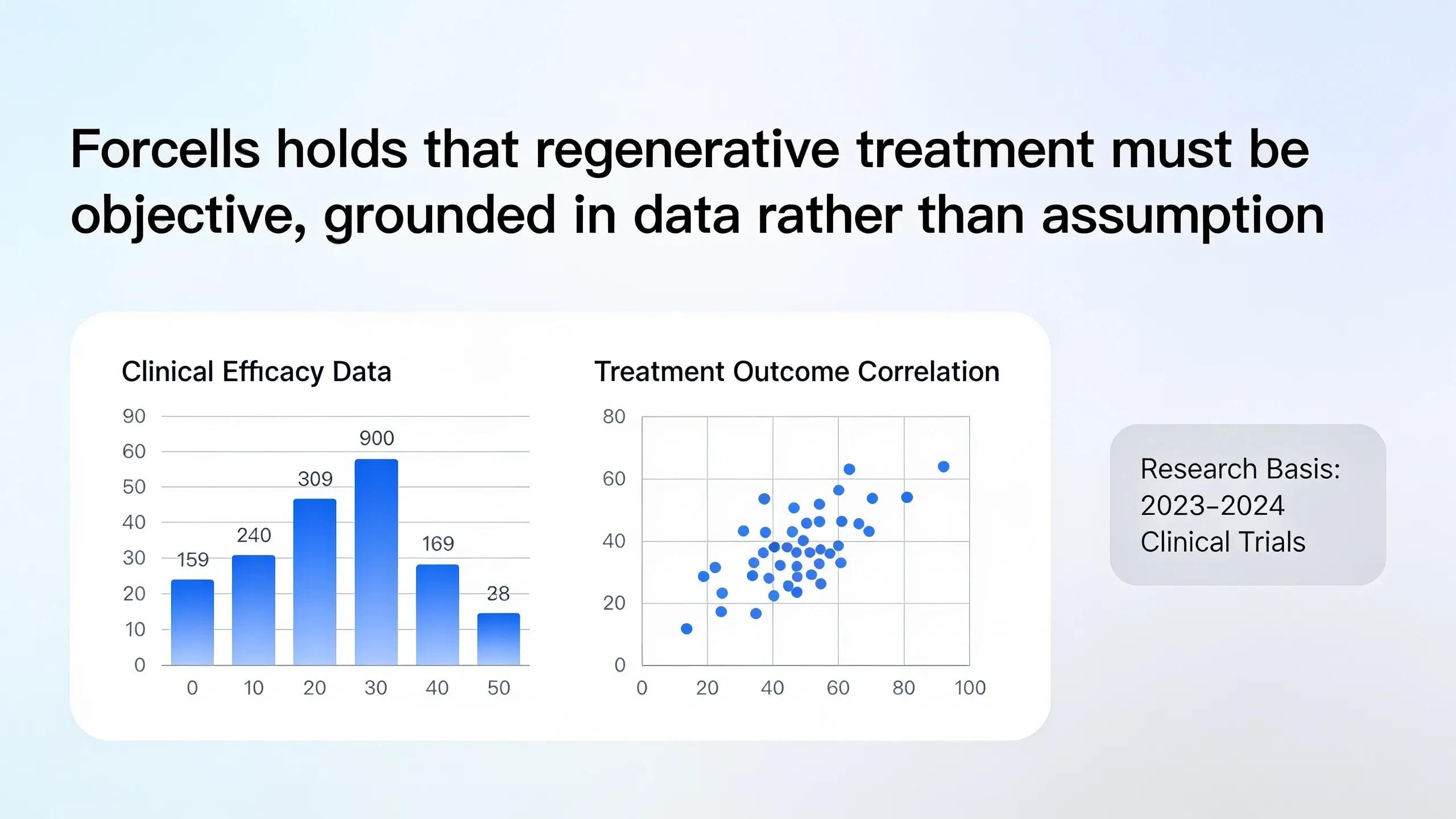
Forcells treats every intervention as a data problem, not a guess. Regenerative treatment stays objective, grounded in measurable tissue findings rather than assumption — and outcomes stay trackable, so patients and physicians can follow progress across the full course of care rather than relying on subjective impressions alone.
Are orthobiologics the same as stem cell therapy?
Stem cell therapy sits inside the broader orthobiologics category, alongside PRP injections and other growth-factor-based approaches. Each pulls from a different biological source, but all aim to activate the body’s own repair mechanisms rather than replace tissue outright.
Do orthobiologics require surgery?
Most orthobiologic treatments, including PRP injections, are delivered without an incision, making them a non-surgical joint care option Brooklyn patients can pursue before considering an operating room. As a research-driven practice, Forcells pairs this approach with advanced protocols and longitudinal outcomes tracking to support Brooklyn patients seeking measurable, physician-guided progress in joint regeneration.
Which Joint Conditions Can Be Addressed?
Four categories of joint damage respond to orthobiologic treatment: articular cartilage injuries, early osteoarthritis, ligament injuries, and tendon injuries. Brooklyn residents delaying surgery because of long recovery times or invasive procedures often qualify for one of these non-surgical pathways. Untreated joint deterioration rarely stays stable — cartilage thins further, ligaments lose stability, and pain compounds with each passing year.
At Forcells, orthobiologics in Brooklyn are matched to the specific joint condition rather than applied as a one-size-fits-all injection. A patient with early-stage knee osteoarthritis presents differently than someone recovering from a rotator cuff tendon strain, so treatment planning stays personalized since no two Brooklyn patients experience joint damage the same way, even when the diagnosis sounds identical on paper.
Can orthobiologics help hip and groin pain specifically?
Hip and groin pain gets its own dedicated orthobiologic approach, separate from general joint protocols. This distinction matters because hip injuries involve different biomechanics and tissue structures than knees or shoulders. Brooklyn patients with hip-related discomfort benefit from an evaluation focused specifically on that joint’s condition.
Is early osteoarthritis treatable without surgery?
Early osteoarthritis is among the conditions orthobiologics are designed to address, particularly before cartilage loss becomes severe. Catching degeneration early — sometimes alongside options like viscosupplementation injections to support joint lubrication — expands the range of non-surgical treatments available.
Every recommendation stays evidence-driven, built on current research and clinical findings before any care begins. This principle guides joint regeneration planning in Brooklyn across each condition type:
Articular cartilage injuries
Early osteoarthritis
Ligament injuries
Tendon injuries
Hip and groin-specific conditions
Non-surgical joint care in Brooklyn through Forcells starts with understanding which of these categories applies before any intervention is proposed.
Why Consider Forcells Over Surgery First?
Surgery replaces or repairs joint tissue after damage has already progressed. Orthobiologics in Brooklyn work earlier in that timeline, using the body’s own biology to address joint pain before an operating room becomes the only option. For a Brooklyn resident weighing knee, shoulder, or hip surgery, that distinction carries real weight: fewer irreversible steps, less downtime, and a chance to see measurable results before committing to a scalpel.
Forcells built its approach around a simple idea: regenerative medicine should never be a guess. Every protocol is measured and refined for the individual rather than applied as a one-size-fits-all fix, a standard that traces back to founder Dr. John P. Cole, who has spent more than three decades emphasizing objective measurement and individualized treatment planning for patients with orthopedic conditions.
Is orthobiologic treatment as effective as surgery for joint pain?
Effectiveness depends on the joint, the injury, and the patient’s biology, which is exactly why individualized planning matters. Forcells studies each patient’s tissue dynamics before recommending PRP injections, stem cell therapy, or any other intervention — the goal is always to help the body repair itself rather than replace tissue outright.
What makes non-surgical joint care different from a standard injection?
The difference lies in the engineering behind the protocol, not just the substance injected.
Objective assessment of the joint before treatment begins
Personalized planning based on individual tissue condition
Evidence-driven decisions, not standardized guesswork
A biologically informed process aimed at repair, not replacement
For Brooklyn patients exploring non-surgical joint care, this measured framework offers a data-backed alternative to weigh before a surgical consultation becomes the next step.
Ready to Discuss Non-Surgical Joint Care?
A consultation starts the process, not a procedure. Brooklyn residents dealing with chronic knee, shoulder, or hip pain can review their options, including PRP injections and stem cell therapy, before committing to any treatment path. At Forcells, evaluation always comes before intervention.
Every case begins with the tissue itself. Understanding a joint’s condition must come before attempting to change it, and that principle shapes each personalized consultation offered to Brooklyn patients, replacing guesswork with structured assessment.
What happens during a joint consultation?
Consultations focus on evaluating the affected joint, tracking findings, and mapping a course forward. Brooklyn patients receive outcomes tracking paired with longitudinal care, so progress can be followed visit after visit rather than assumed.
Is non-surgical treatment realistic for chronic pain?
Recent advances in orthobiologic injections make it possible to address chronic joint pain effectively, without invasive surgery. This shift matters for Brooklyn residents weighing surgical recovery against a less disruptive path — a consultation is how to determine whether that path, whether PRP, stem cell therapy, or another approach, fits a given case.
Delaying a conversation does not preserve options — it narrows them. Scheduling a consultation is the next step toward an informed decision.
Orthobiologics offer a scientifically grounded approach to joint pain that puts objective measurement and personalized treatment planning first. At Forcells® Regenerative Medicine, we work to understand each patient’s unique tissue condition before recommending any intervention, so treatment addresses the biological factors actually driving joint dysfunction — not just the symptoms.
FAQ
What are orthobiologics?
Orthobiologics are natural substances drawn from the body’s own repair systems — cells, tissue, blood components, and growth factors — used to treat joint damage, including through PRP injections and stem cell therapy, without surgery.
What conditions do orthobiologic injections treat?
Orthobiologics address articular cartilage injuries, early osteoarthritis, ligament injuries, and tendon injuries, targeting tissue that has lost structural integrity from cartilage breakdown, tendon strain, or ligament damage.